Sadhana Manthapuri, PhD · Oct 19, 2026
Global conflicts, trade uncertainty, technological change, and national policy shifts dominate public debate. This month, finance ministers met in Bangkok for the IMF and World Bank Annual Meetings, where Kristalina Georgieva said, “We are in a place where we have many more questions than we have answers.”
Yet the consequences of these decisions reach far beyond national budgets and economic indicators. They land on the local governments, businesses, and communities responsible for turning policy into tangible outcomes.
The bill is already arriving. In Peabody, Massachusetts, schools expect an unplanned $100,000 in diesel costs this year, and the city’s chief financial officer put it plainly: “This equates to the cost of a teacher.” In San Francisco, the transit agency has been spending about 58% more on fuel each month than before the war in Iran, on top of a $307 million operating deficit.
The overlooked problem is the growing gap between policy ambition and local capacity to deliver.
A case in point: FEMA’s BRIC program
Consider FEMA’s Building Resilient Infrastructure and Communities (BRIC) program, which funds projects that reduce disaster risk before disasters strike. In September 2026, the U.S. Government Accountability Office (GAO) reported that 700 community applications, worth about $2.2 billion, still had no final award decision as of March 2025.
FEMA then announced the end of BRIC in April 2025 and its restart in March 2026. In between, it awarded no subgrants and obligated no funds, and communities planning infrastructure and disaster mitigation projects were left waiting.
The costs did not stop at the waiting. Officials told GAO that the lack of actionable information delayed mitigation work, and state officials reported that some local recipients stopped work because of the uncertainty, which may raise project costs. As of March 2025, FEMA had reimbursed $62 million of the $2.5 billion allocated to 1,245 projects.
GAO also found that FEMA did not use performance information to inform its decision to end the program. This reveals a broader governance challenge: national decisions can generate local costs that are not fully captured in the original policy calculation.
Three ways national decisions become local costs
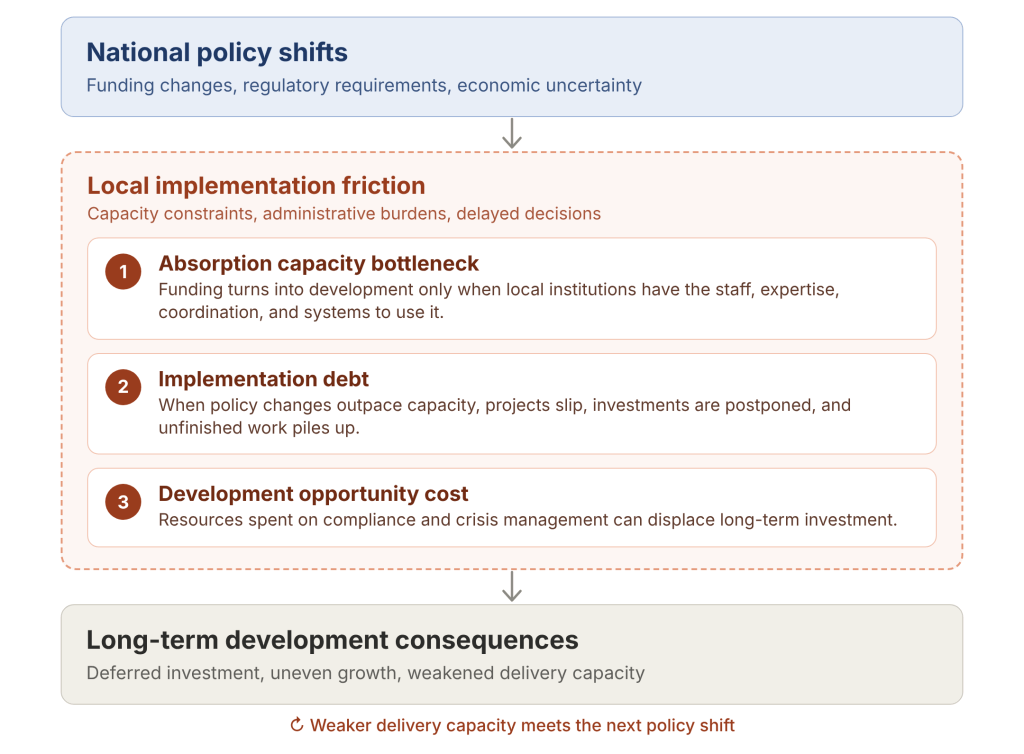
Three concepts help explain how these costs emerge.
- The absorption capacity bottleneck. Funding and policy opportunities do not automatically translate into development. Local institutions need adequate staff, expertise, coordination, and administrative systems to implement them, and every change in rules or timelines is absorbed by those same people.
- Implementation debt. When policy changes and administrative demands outpace institutional capacity, projects are delayed, planned investments are postponed, and unfinished work accumulates. BRIC shows how fast this debt builds: eleven months without awards, projects that stopped work, and costs that may rise when work resumes.
- The development opportunity cost. Resources redirected toward immediate compliance, uncertainty, or crisis management may displace longer-term investments in infrastructure, workforce development, and economic growth. Peabody’s extra diesel bill equals a teacher’s salary, money that no longer goes to what the community planned to build.
How national decisions affect local development
What would help
These outcomes are not inevitable. Four changes would narrow the gap between what policy promises and what places can deliver.
- Count the local bill. Every major national decision should estimate what it will cost city and county budgets in staff time, delays, and higher prices, not only what it allocates.
- Keep the rules steady. Stable timelines and clear communication let local governments plan. GAO’s seven recommendations for BRIC include assessing how FEMA communicates externally and setting performance goals it actually measures.
- Fund delivery capacity, not just projects. Support for planning, project management, and administration helps places with thin staff turn awards into results.
- Build buffers before the next shock. Massachusetts school districts that had locked in fuel prices bought themselves a year. Local governments need similar protection against price spikes and funding gaps.
The real test of policy
These costs raise an important question for policymakers: are we evaluating public policy by what governments announce and allocate, or by what communities can realistically implement? As Babatunde Ahonsi, the UN Resident Coordinator in Türkiye, said at a recent local climate dialogue ahead of COP31, “global commitments are ultimately delivered locally, or they are not delivered at all.”
Understanding the institutional friction between national decisions and local capacity is essential to explaining why similar policy opportunities produce different outcomes across places. The real test of policy is not simply what it promises, but what local institutions are equipped to deliver.
I would like to hear where you have seen this gap in your own city, county, or region.
Sources
- U.S. Government Accountability Office, FEMA: Billions in Building Resilient Infrastructure and Communities Subgrants Remain Unawarded (GAO-26-107774), September 24, 2026
- Reuters, IMF/World Bank meetings leave developing countries with more questions than answers, October 18, 2026
- The Boston Globe, Schools face an unanticipated problem: Soaring fuel costs are threatening their budgets, October 12, 2026
- The San Francisco Standard, The Iran War has sent Muni’s fuel costs soaring 58%, October 6, 2026
- UN Türkiye, Muğla dialogue brings local climate priorities to the road to COP31


Leave a Reply