A practical global guide to AI knowledge, skills, institutional capacity, governance and context for governments and development practitioners
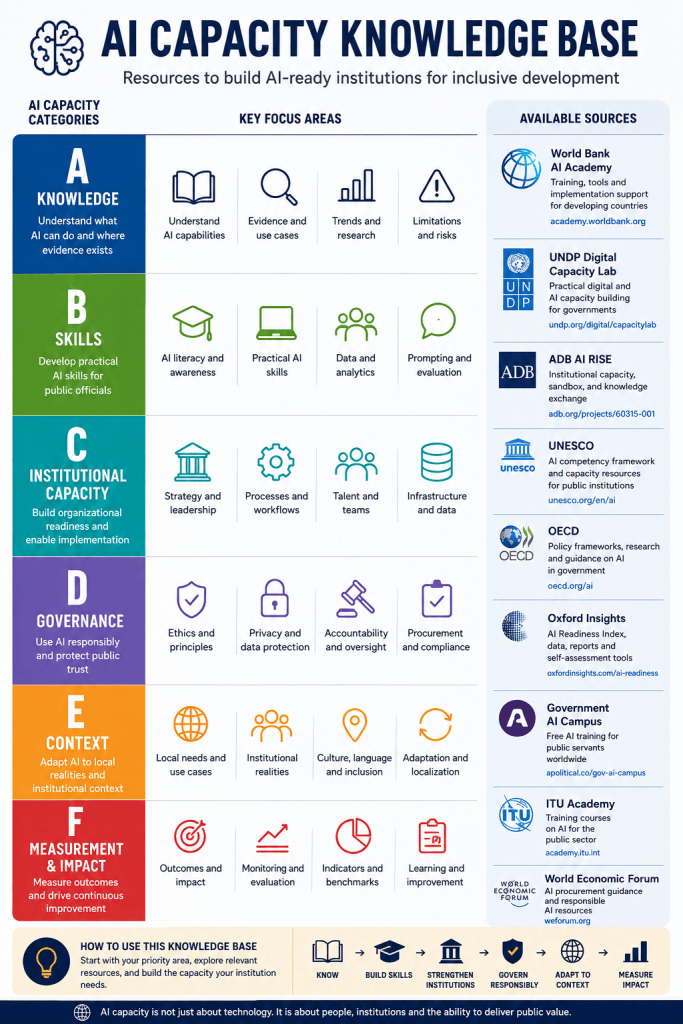
We already know that AI is here.
It is writing our emails, translating languages, analysing data, generating images, helping us code, summarising reports and increasingly influencing how organisations make decisions.
Governments are no exception.
Across the world, public institutions are experimenting with AI to improve public services, analyse information, automate processes and support policymaking.
But there is a problem we don’t talk about enough:
Access to AI is not the same as access to the capacity to use AI well.
A policymaker in Singapore, a municipal official in Kenya, a civil servant in Bangladesh and a local government officer in Nepal may all technically have access to the same AI tools.
But they do not necessarily have the same:
- knowledge of what AI can actually do;
- practical skills to use it;
- institutional systems to deploy it;
- governance frameworks to manage risk;
- data and digital infrastructure;
- procurement capacity; or
- ability to adapt AI to their own institutional and local context.
And that difference could become one of the defining development gaps of the AI era.
The next digital divide may not be access to AI.
It may be capacity to use AI.
This distinction matters.
The first digital divide was largely about connectivity.
The next one may be about capability.
Having an internet connection did not automatically mean a person could benefit from the digital economy.
Likewise, giving a government access to ChatGPT, Gemini or another AI system does not automatically make that government AI-ready.
A government can have an AI strategy and still lack the people who know how to implement it.
It can have data and still lack the institutional systems to use that data.
It can procure an AI system and still lack the capacity to evaluate whether it works.
And it can adopt an AI tool without having the governance mechanisms needed to understand what happens when that tool makes a mistake.
The OECD’s latest work on AI in government makes this point particularly clearly: AI use is spreading rapidly, but the underlying conditions required to scale it—including skills, data governance, infrastructure, procurement and organisational capacity—remain uneven.
That means AI readiness is not simply a technology problem.
It is a capacity-building problem.
So what does an AI-ready government actually need?
I think about this through five connected layers.
A — Knowledge
Knowing what AI can do — and where relevant evidence exists.
Government officials need more than generic AI literacy.
They need to understand:
- What problems can AI realistically solve?
- Where has it worked elsewhere?
- What are the limitations?
- What evidence exists?
- Which use cases are relevant to their sector?
- What should not be automated?
Knowledge is the starting point.
B — Skills
Knowing how to actually use AI.
This is where the conversation needs to move beyond “AI awareness.”
Officials increasingly need practical skills such as:
- using generative AI;
- analysing and interpreting data;
- writing effective prompts;
- evaluating AI outputs;
- identifying hallucinations and bias;
- designing AI-assisted workflows;
- translating policy problems into potential AI use cases; and
- working with technical teams and vendors.
The goal isn’t to turn every civil servant into a machine-learning engineer.
It is to create a public workforce that is AI-confident enough to use, question and manage AI.
The World Bank’s AI Academy for Governments is one example of this direction: its programme combines knowledge, practical tools, peer networks and implementation-oriented learning for officials from developing countries.
D — Institutional capacity
Can the organisation actually implement what it has learned?
This is the layer that is often missing.
An individual may know how to use AI.
But can their ministry?
Can their municipality?
Can their department procure it?
Can it integrate AI into existing workflows?
Who owns the system?
Who evaluates performance?
Who manages the data?
Who is responsible when something goes wrong?
AI adoption therefore requires organisational capacity—not simply individual training.
UNDP’s Digital Capacity Lab takes a similar approach, combining practical training with context, experimentation, prototyping and institutional capacity development. Its programmes explicitly target governments and developing-country contexts.
E — Governance
Can AI be used responsibly?
Governments have a particularly difficult responsibility.
They are not simply users of AI.
They are also:
buyers → regulators → service providers → data stewards → policymakers → institutions of public trust.
That creates questions around:
- privacy;
- procurement;
- transparency;
- accountability;
- bias;
- human oversight;
- cybersecurity;
- intellectual property;
- data governance; and
- public trust.
The OECD identifies governance, data, digital infrastructure, skills, investment, procurement and partnerships as critical enablers for AI in government.
The World Economic Forum has similarly highlighted the difficulty governments face in procuring AI when officials may lack the technical and governance expertise to evaluate vendors and solutions.
F — Context
Can AI actually work in this country’s institutional reality?
This may be the most important—and most overlooked—question.
A solution that works in Estonia does not automatically work in Ghana.
A model developed for the United States may not work in India.
A national AI strategy cannot simply be copied from one country to another.
Institutions differ.
Data differs.
Languages differ.
Administrative capacity differs.
Budgets differ.
Political systems differ.
Infrastructure differs.
Citizen expectations differ.
And the consequences of failure differ.
AI capacity building therefore has to be contextual.
The objective shouldn’t be to make every government look technologically identical.
It should be to help each government identify:
What can AI do here, for these people, through these institutions, under these constraints?
The good news: the resources already exist.
One of the most encouraging things I found while mapping this landscape is that governments and international organisations are not starting from zero.
There is already an expanding global ecosystem of AI training, frameworks, research, datasets, readiness assessments and implementation resources.
The problem is that these resources are fragmented.
You may find an excellent course in one place, a government readiness index somewhere else, an AI governance framework on another website and a useful dataset buried inside a research report.
So I started organising them.
Think of the map below as a starting point—not a ranking.
The Global AI Capacity Resource Map
1. KNOWLEDGE — Understand AI and its development implications
World Bank Group AI Academy for Governments
Resource type: Training + courses + implementation tools
The World Bank Group’s AI Academy for Governments is designed specifically for officials from developing countries. It takes participants from AI strategy toward implementation, including infrastructure, data governance, institutional capacity and investment considerations.
Explore the World Bank Group AI Academy
Best for: Government leaders and policymakers moving from AI awareness toward implementation.
ADB — Artificial Intelligence in Action
Resource type: Report + case studies + development evidence
The Asian Development Bank’s publication examines how AI is being applied across areas including economics, administration and development operations, while also discussing the need for technology and training.
Explore ADB’s AI in Action publication
Best for: Development practitioners looking for real-world applications in Asia and the Pacific.
Oxford Insights — Government AI Readiness Index
Resource type: Index + country data + reports + methodology
The 2025 Government AI Readiness Index assesses 195 governments and provides country, regional and comparative analysis of government capacity to harness AI. It also provides downloadable index data and methodology.
Explore the Government AI Readiness Index
Best for: Researchers, policymakers and development organisations comparing national AI readiness.
2. SKILLS — Learn how to actually use AI
UNDP Digital Capacity Lab
Resource type: Courses + training programmes + practical learning
UNDP’s Digital Capacity Lab provides training for governments in digital transformation, data, AI and related areas. Its approach emphasises practical, context-sensitive learning rather than technology for its own sake.
Explore UNDP’s Digital Capacity Lab
UNDP DAI Academy
Resource type: Free, self-paced courses
The DAI Academy provides free, open-access courses covering digital transformation, digital public infrastructure, data governance and AI. It is designed for government officials, policy advisers and development practitioners and includes country case studies and practical take-away artefacts.
Best for: Someone who wants to start learning immediately without needing a technical background.
Government AI Campus
Resource type: Training + courses + community
The Government AI Campus, powered by Apolitical, was created to help public servants build AI capabilities. By May 2026, it reported more than 500,000 public servants across 163 countries, with training available in 12 languages.
Explore the Government AI Campus
Best for: Public servants looking for accessible, practical AI learning.
UNESCO Digital Competency Framework for Civil Servants
Resource type: Competency framework + guidance + resources
UNESCO’s framework focuses on strengthening human and institutional digital capacity among civil servants and provides guidance for developing the competencies needed in a rapidly changing technological environment.
Explore UNESCO’s Digital Competency Framework
ITU / UNESCO — AI for the Public Sector
Resource type: Structured training course
ITU and UNESCO have developed public-sector AI training covering AI fundamentals, public-sector applications, procurement, ethics, governance and the process of developing AI-based public services. Recent versions have specifically targeted government officials, policymakers and regulators from developing countries.
Explore ITU Academy’s AI public-sector courses
3. INSTITUTIONAL CAPACITY — From individual skills to organisational readiness
This is where the conversation becomes much more interesting.
Training one official is useful.
Building an institution that can continuously learn, experiment, govern and scale AI is much more powerful.
ADB — AI RISE
Resource type: Institutional capacity + diagnostics + pilots + knowledge exchange
ADB’s AI RISE initiative is designed to strengthen AI-ready infrastructure, support high-impact AI solutions and build institutional capabilities for responsible and sustainable AI-enabled development.
Explore ADB’s AI RISE initiative
ADB — Empowering Developing Member Countries through AI
Resource type: Technical assistance + AI expertise + sandbox + knowledge exchange
ADB’s programme combines AI expertise, digital public goods, an AI Sandbox and institutional capacity building across developing member countries.
Explore the ADB AI capacity initiative
OECD — Building an AI-Ready Public Workforce
Resource type: Policy research + workforce strategies
The OECD’s 2026 work focuses directly on the challenge of building an AI-ready public workforce, including training, hiring digital and data professionals, innovation and continuous learning.
Read the OECD’s AI-ready public workforce brief
4. GOVERNANCE — Use AI without losing public trust
OECD — Governing with Artificial Intelligence
Resource type: Research + framework + policy guidance
The OECD’s work provides a comprehensive look at how governments can use AI while addressing risks around transparency, accountability, data, skills, procurement and institutional capacity.
Explore OECD’s work on governing AI
World Economic Forum — AI Procurement Guidelines
Resource type: Procurement guidance
For governments, buying AI is itself a capacity challenge.
The World Economic Forum’s work focuses on responsible AI procurement and the different actors involved in the procurement lifecycle.
Explore the WEF AI procurement guidelines
Oxford Insights — Trustworthy AI Self-Assessment
Resource type: Self-assessment tool
Oxford Insights also provides a free downloadable tool to help policymakers assess their government’s preparedness for trustworthy AI use.
Explore Oxford Insights’ AI readiness resources
5. CONTEXT — Because one country’s AI solution is not another country’s solution
This is the category I think deserves much more attention.
AI capacity cannot be separated from development context.
ADB’s current digital transformation strategy, for example, explicitly connects AI with digital connectivity, skills, cybersecurity, privacy, data governance and responsible use across Asia and the Pacific.
ADB’s AI RISE programme similarly recognises that developing countries face constraints around infrastructure, fragmented data ecosystems, interoperability, governance and digital skills.
UNDP’s approach also explicitly emphasises contextual and demand-driven capacity building, rather than assuming that one model works everywhere.
This is critical.
The goal should not be AI adoption for its own sake.
The goal should be development outcomes.
So what kind of resource is each one?
If you are trying to navigate this landscape, don’t treat every resource as a “course.”
They serve very different purposes.
| Resource type | What it helps you answer | Examples |
|---|---|---|
| Training | How do I learn AI? | Government AI Campus, UNDP |
| Courses | What can I learn step-by-step? | UNDP DAI Academy, ITU |
| Frameworks | What capabilities do we need? | UNESCO, OECD |
| Data | Where does my country stand? | Oxford Insights |
| Indexes | How does readiness compare? | Government AI Readiness Index |
| Reports | What does the evidence say? | OECD, ADB |
| Case studies | What has worked elsewhere? | ADB, World Bank |
| Self-assessments | How ready are we? | Oxford Insights |
| Implementation programmes | How do we move from strategy to action? | World Bank AI Academy, ADB AI RISE |
| Procurement guidance | How do we buy AI responsibly? | World Economic Forum |
| Communities | How do we learn from other governments? | Government AI Campus / Apolitical |
This distinction matters.
A course can teach you how to use AI.
An index can tell you where you stand.
A framework can tell you what capabilities you are missing.
A case study can show you what another country tried.
But none of them alone creates an AI-ready institution.
The missing layer: connecting the pieces
This is where I think the global conversation needs to go next.
We have:
Knowledge.
We have:
Training.
We have:
Readiness assessments.
We have:
Governance frameworks.
We have:
Case studies.
We have:
Data.
We have:
AI tools.
But these resources often exist in separate silos.
A government official may know that an AI readiness index exists but not know what to do after seeing their score.
A policymaker may complete an AI course but still not know which use cases make sense for their ministry.
A government may identify a promising AI application but lack procurement or governance capacity to implement it.
And a country may copy a successful international example without asking whether its institutional conditions are comparable.
The challenge is therefore shifting from access to resources to the ability to navigate and apply them.
A simple starting point
If you are a government official, policymaker or development practitioner wondering where to begin, I would suggest this sequence:
01 — KNOW
What can AI actually do?
Start with introductory learning and real government use cases.
↓
02 — ASSESS
Where are we today?
Look at AI readiness, digital infrastructure, data and institutional capacity.
↓
03 — BUILD SKILLS
What do our people need to learn?
Move beyond general awareness toward role-specific capabilities.
↓
04 — IDENTIFY
Which problems are worth solving?
Start with public-sector problems—not technology.
↓
05 — GOVERN
What safeguards do we need?
Consider privacy, procurement, accountability, transparency and human oversight.
↓
06 — ADAPT
Will this work in our context?
Ask what needs to change for your country’s institutions, resources, language, data and citizens.
↓
07 — IMPLEMENT
Can we actually deliver it?
Build the organisational systems, partnerships and leadership required to move beyond pilots.
AI is not going to wait for governments to become ready.
That is precisely why capacity building matters.
The World Bank is already building implementation-oriented AI capacity for developing-country officials. ADB is investing in AI readiness, infrastructure and institutional capabilities. UNDP is expanding practical digital and AI training. OECD is examining how governments can build AI-ready workforces. UNESCO and ITU are developing competency and training approaches. And organisations such as Oxford Insights and Apolitical are building tools and knowledge ecosystems around government AI readiness.
The pieces are emerging.
Now we need to connect them.
Because the biggest risk of the AI era may not be that some governments use AI and others don’t.
It may be that some governments develop the capacity to understand, question, govern and deploy AI, while others are left consuming technologies they did not design, cannot fully evaluate and do not have the institutional capacity to manage.
That is not simply an AI gap.
It is a development gap.
And if we want AI to contribute to more inclusive development, capacity building cannot be an afterthought.
It has to be part of the infrastructure of the AI transition itself.
A living resource map
I will continue updating this list as new government AI courses, datasets, frameworks, assessments, case studies and implementation resources emerge.
If you know of a high-quality resource—particularly one designed for developing countries, public servants or local governments—send it my way.
The objective is simple:
Make it easier for anyone, anywhere, to find the knowledge and capacity they need to navigate the AI era.
This is a curated resource map, not an endorsement or ranking of the organisations listed above. Availability, eligibility and programme dates can change, so check the linked source before applying or relying on a resource.
 sadhanamanthapuri.com
Leave a comment