Over the past few days, I have been working on an AI startup idea and reading more about the rapid emergence of Generative AI.
Much of the conversation today is about how we use AI: Which model is more accurate? Is ChatGPT better than Claude or Perplexity? Can we trust AI for policy research and data analysis?
But I think there is a much bigger question we should be asking:
Are countries equally prepared to benefit from the AI transition?
Two recent reports point to a concerning reality.
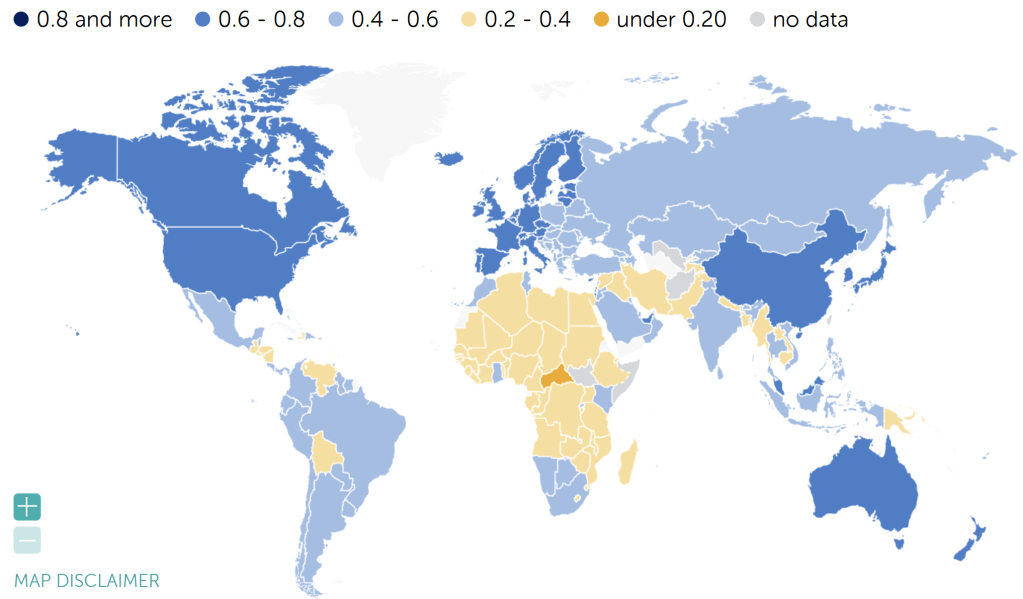
In 2024 the IMF published an AI Preparedness Index covering 174 economies. It scores each country from 0 to 1 across four dimensions: digital infrastructure, human capital and labour-market policies, innovation and economic integration, and regulation and ethics. It is a blunt instrument, but the spread is hard to argue with.
Advanced economies average 0.68. Emerging markets average 0.46. Low-income countries average 0.32.
The exposure numbers cut the other way, which is what makes this interesting. The IMF estimates that around 60 percent of jobs in advanced economies are exposed to AI, against 40 percent in emerging markets and 26 percent in low-income countries. Read quickly, that sounds like insulation. It isn’t. Exposure is where AI can act — and therefore where it can raise productivity. Low exposure combined with low preparedness is not protection. It is being outside the room.
The IMF’s own modelling makes the consequence explicit. Its April 2025 working paper, The Global Impact of AI: Mind the Gap, projects global output rising by close to 4 percent over a decade in its optimistic scenario — distributed as roughly 5.6 percent for the United States, 4.4 percent for the EU and Switzerland, 3.0 percent for emerging markets, and 2.7 percent for low-income countries. The paper’s own summary of the result is blunter than anything I would write: the growth impact in advanced economies could be more than double that in low-income countries.
That is not a technology gap. That is a compounding gap.
Where the models are actually built
Stanford HAI’s AI Index tells the supply-side half of the same story. In its 2025 edition, the United States produced 40 notable AI models in 2024. China produced 15. Europe, combined, produced 3. Everywhere else was in single digits or absent entirely. And industry — not universities, not public labs — accounted for nearly 90 percent of those models, up from around 60 percent the year before.
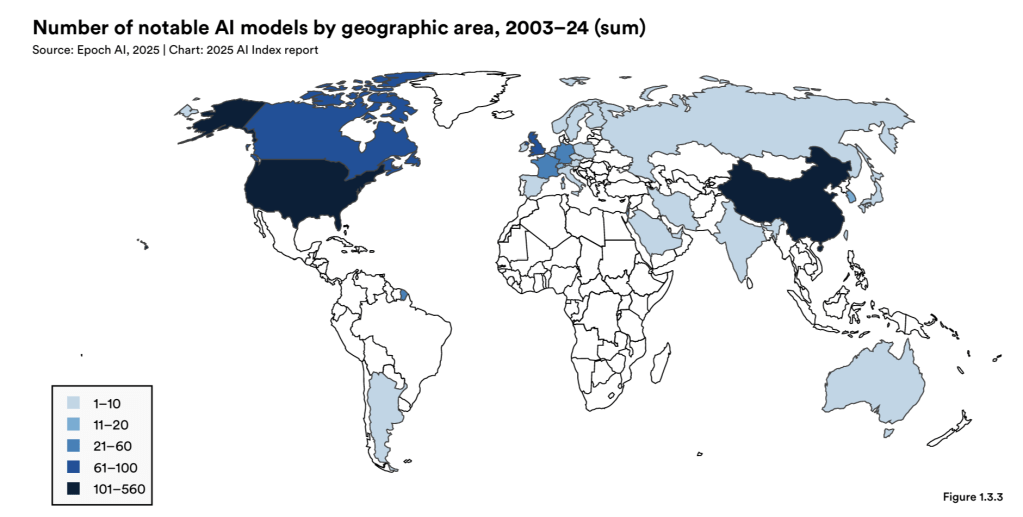
The 2026 edition shows the concentration holding. The US released roughly 50 notable models in 2025, and the infrastructure picture is starker than the model counts: the US hosts more than 5,400 data centres, over ten times any other country, while South Asia, Latin America, and the Middle East and North Africa each hold fewer than ten state-backed AI supercomputing clusters.
One correction to an assumption I carried in: the US leads on frontier model output, but not on everything. China now files the large majority of AI patents and leads on publication volume, and the EU has moved further and faster on regulation. “American dominance” fairly describes frontier model production and compute. It does not fairly describe the whole field.
The gap that closed is not the gap that matters
Here is the part that routinely gets misread. The AI Index also documents a dramatic convergence: over 2024, the performance gap between top US and Chinese models collapsed on standard benchmarks — MMLU from 17.5 percentage points to 0.3, MATH from 24.3 to 1.6, HumanEval from 31.6 to 3.7.
This gets reported as “the gap is closing.” It is — between two countries that already had national compute programmes, domestic chip and cloud sectors, deep research bases, and the capital to spend hundreds of billions a year. China closed that gap by building the same stack, not by borrowing anyone else’s.
The North–South gap is a different shape entirely, and nothing in the current data suggests it is closing.
Why this feels familiar
Every general-purpose technology has run this pattern: steam, electrification, containerised shipping, broadband. The technology diffuses eventually. The advantage accrues to whoever was ready when it arrived, and it compounds for a generation before diffusion catches up. Countries that industrialised late did not merely arrive late — they arrived into terms of trade set by whoever arrived first.
What is different this time is speed. Training compute for notable models has been doubling roughly every five months. The interval between “this is a research result” and “this is embedded in the systems that run an economy” is now measured in quarters. A national AI strategy that takes three years to draft is not a late strategy. It is an irrelevant one.
What I think this means
I don’t think the useful response is to try to build a frontier lab. For most countries that isn’t a realistic goal, and chasing it burns the budget that actually matters.
The four AIPI dimensions are a reasonable priority list precisely because three of them are achievable without frontier compute. Human capital, regulation, and economic integration are policy choices. Compute access can increasingly be rented, pooled regionally, or negotiated. What cannot be improvised is a workforce that can deploy and audit these systems, and a regulatory environment that lets them be used in health, agriculture, logistics and public administration without either blocking adoption outright or importing someone else’s risk assumptions wholesale.
The countries that do well over the next decade probably won’t be the ones that built the models. They’ll be the ones that were ready to use them — and that decided for themselves what “ready” meant, rather than inheriting the definition.
That decision has a deadline. On current evidence, it is closer than most national strategies assume.
 sadhanamanthapuri.com
Leave a comment