
When grocery store shelves went empty during COVID, cities didn’t fail.
Their dependencies did.
Yet when we talk about the future of cities, the conversation almost always circles the same terrain: affordability, economic stability, environmental quality, and infrastructure. These are important. But one of the most defining conditions of urban life is still treated as an afterthought: how deeply cities rely on other places to function at all.
Cities are not self-contained systems. They never have been. They are nodes, intensely connected and constantly exchanging goods, labor, services, energy, and information with other urban and rural settlements. COVID made this visible in a way no academic paper ever could. What broke down was not just local service delivery, but the wider networks that cities quietly depend on every day.
I’ve seen this interdependence play out in very different ways.
In India, daily urban life is still tightly tied to nearby villages. In many cities, fresh food and basic goods travel relatively short distances, often within a 50-kilometer radius, through regionally embedded supply chains. The city eats because the surrounding countryside moves.
After moving to the United States, the contrast was striking. Urban consumption here is largely mediated through large retail chains such as Walmart, Kroger, Target, and Whole Foods. These are supported by logistics systems that stretch across states and countries. The distance between production and consumption is far greater, but the dependence is no less real. The scale has changed. The structure has changed. The reliance has not.
And it is not just food.
Every city is sustained by a dense web of flows: essential and non-essential goods, services, labor, and capital that originate far beyond its administrative boundaries. Expecting cities to become fully self-sufficient is neither realistic nor desirable. The real question is a harder one. Which dependencies are we willing to be vulnerable to, and which ones should we actively govern?
This is where planning often falls short.
Most urban planning and policy curricula still treat interdependence as secondary, something implied rather than analyzed. I first truly grasped its importance during my master’s training in regional planning, when we conducted manual, in-person origin-destination surveys for both people and goods. There was nothing abstract about it. We stood at major entry and exit points of the city and posed simple questions like where they started and why they were going to the city? What stunned me was a mid-sized city like Bhopal. Critical nodes supporting the city, including markets, labor sources, and logistics points, were located up to 45 kilometers away and connected through specific road networks. The city’s daily functioning depended on places most urban plans never even mentioned.
That was the moment it clicked. Cities are shaped not just by what happens within them, but by flows, networks, and nodes that extend far beyond their borders.
This phenomenon is not new, and it is not accidental. Long before supply chains and logistics dashboards, planners were already trying to understand why cities depend on surrounding places. In 1933, Walter Christaller’s Central Place Theory offered one of the earliest frameworks for explaining how settlements organize themselves into networks of centers and hinterlands. The theory showed that cities function as service hubs, relying on a surrounding region to supply goods, labor, and daily needs. What appears today as complex urban dependency was, even then, understood as a spatial logic of flows and proximity.
The conceptual diagram below captures this idea in its simplest form.
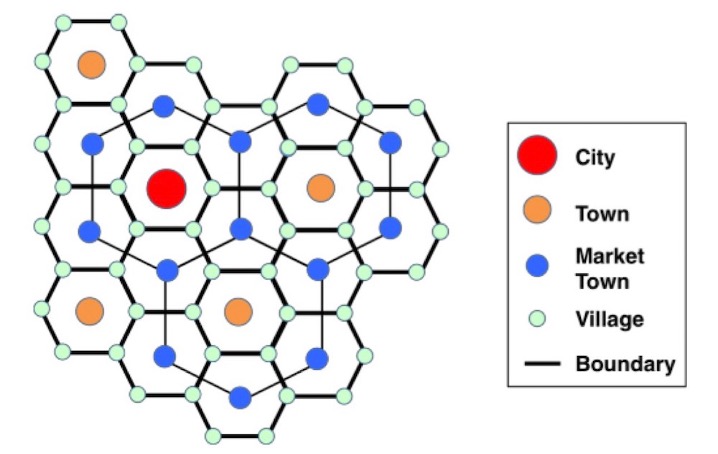
Interdependence is not a weakness of cities. It is a defining condition. But it is one that demands deliberate planning, governance, and strategy. Urban policy needs to move beyond the city-as-island mindset and start asking sharper questions. What needs to be resilient locally? Where does strategic dependence make sense? How do we design systems that acknowledge, rather than ignore, the realities of connection?
The future of cities will not be decided only by what happens inside them. It will be decided by how well they understand and manage the worlds they depend on.
Here are some of the suggested literature:
- Metropolitan Function and Interdependence in the U.S. Urban System
- Measuring city relationship strength beyond total counts: A multidimensional framework for distinguishing prominence from interdependence and significance
- Urban And Regional Typologies In Relation To Self-sufficiency Strategies
- The myth of urban self sufficiency
Now that we have reached the end, it is worth pausing to ask a simple question. Where do the goods that sustain your city actually come from? Which places act as critical nodes in that system? Which roads, ports, warehouses, and labor markets keep everyday life moving
 Contact
Leave a comment